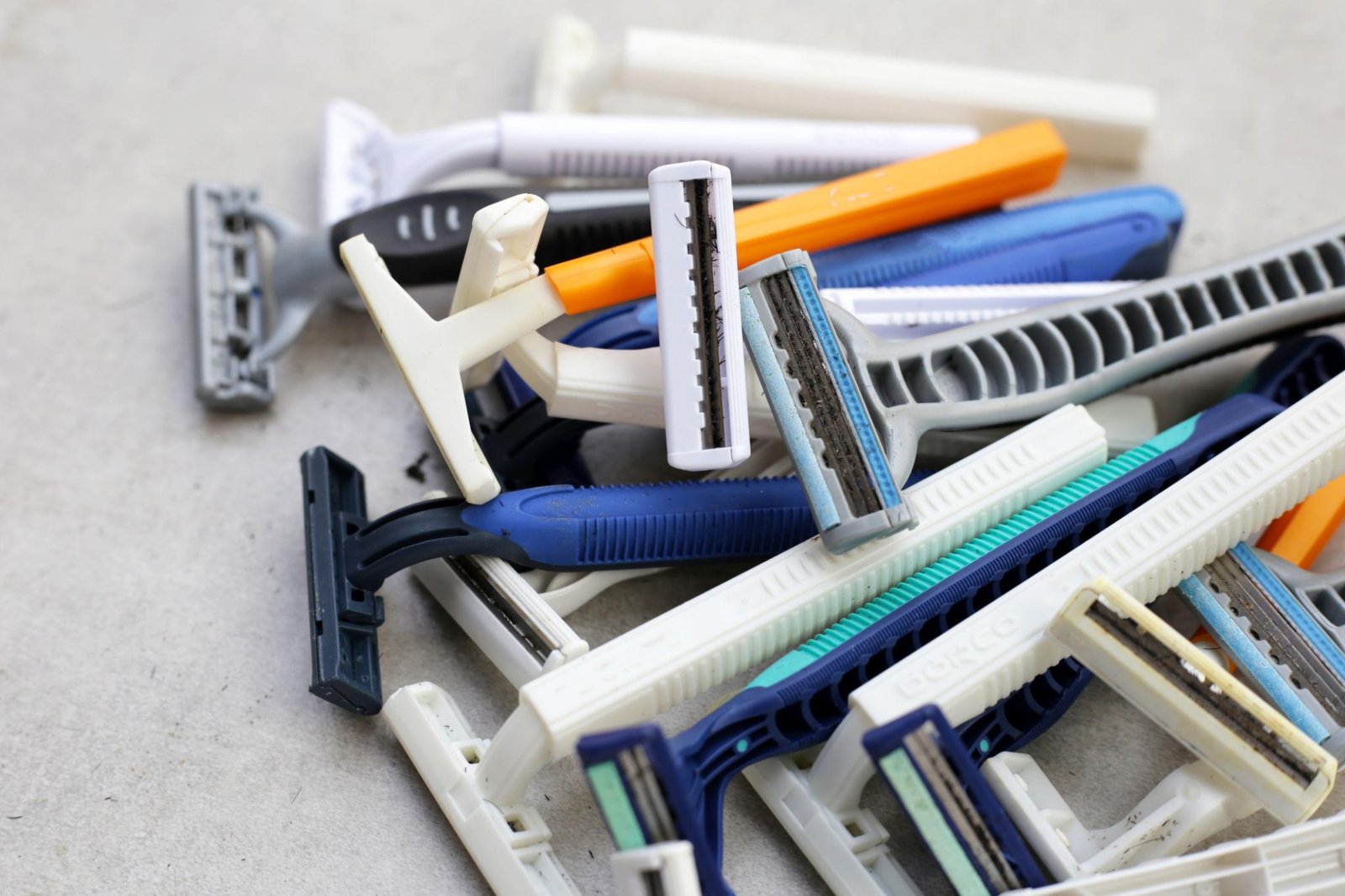

When looking for a long-term solution, the question arises: is there a more sustainable option that reduces this waste without compromising on results?
In April, this issue seems even more topical. World Earth Day points out that sustainability is not limited to recycling and reducing the use of plastic bags. It also lies in small, everyday choices – including personal care.
Hair removal is rarely thought of as a source of waste. It’s part of our daily routine – a quick, familiar and almost automatic action. But that is precisely where the problem lies: the frequency.
A disposable razor is used a few times and then thrown away. The plastic handles and metal blades are difficult to separate for recycling. In most cases, they remain in the depots for decades.
Hair removal creams seem like a gentler alternative, but Every tube, every cap and every piece of packaging also has a long life as rubbish after use. Added to this is the chemical composition, which is washed away and ends up in the water system.
The car’s bonnet isn’t without a scratch either. Tapes, spatulas, packaging, product residue – All of this is a one-off process. Even when the result is good, the process has to be repeated over and over again.
The problem isn’t the individual action. The problem is the cumulative effect.
Laser hair removal It changes not only the way hair is removed, but also how often this needs to be done.
Once a course of treatment has been completed, hair growth decreases significantly. This means less need for maintenance and, consequently, fewer repetitive actions that generate waste.
From an environmental point of view, there is another important difference. With professional equipment, consumables are kept to a minimum. In our case, we use two devices, in which The main consumable is optics – glass. We do not rely on single-use plastic attachments, nor on products that are discarded after each treatment. Even if we factor in the use of medical gloves and disinfectant supplies, given that a person visits us 6 to 10 times for different areas of hair removal, the amount of waste generated by daily shaving over a lifetime is incomparable.
This is also a natural fit for frequently searched topics such as advantages of the alexandrite laser, laser hair removal for sensitive skin и A comparison between laser and photoepilation – because the choice is no longer merely an aesthetic one, but also has long-term implications.

The figures help to illustrate the true scale behind what is otherwise an everyday habit.
Over the past 8 years in Body Aesthetics Over 6,000 clients have had their hair removed using laser hair removal. In order to assess the environmental impact, a realistic comparison must be made with the most commonly used method – disposable razors.
According to various market and consumer analyses, the average use of razors varies considerably, depending on habits, the areas shaved and the frequency of replacement. Data from Euromonitor International and summarised consumer surveys cited by Statista, show that, that many users replace their electric razor or its head every 1–2 weeks.
In addition, dermatological recommendations published by American Academy of Dermatology, also encourage the frequent replacement of the blades in order to prevent irritation and infections, which further increases annual consumption.
On this basis, it can be assumed that the realistic range is between 40 and 56 razors a year, with an average figure of around 45 units likely to be close to actual consumption.
This means:
With 6,000 customers, the result is:
Even with this more conservative estimate, we are talking about over 2.1 million razors, which have not been produced, used or disposed of, and shows just how much the frequency of this habit affects the amount of waste.
This isn’t just a statistic. It’s a measurable result of a choice that is made once, but which reduces the need for hundreds of repetitive actions over time.
It’s hard to visualise a number like that. Perhaps it’s easier to imagine 130 tonnes of plastic? These are 7 full lorries of waste from razors, which would otherwise end up in landfill, in the soil, in the oceans, and as micro-particles – in our own bodies.
This type of waste does not break down quickly. Some of it remains in the soil, whilst some reaches water bodies, where it breaks down into microplastics.
It is precisely here that the choice of hair-removal method goes beyond mere personal convenience. TIt is also significant in a broader context.
Electric razors pose a particular problem when it comes to waste. They are made from a combination of plastic and metal, which makes them difficult to separate and virtually unsuitable for standard recycling.
According to information from TerraCycle, most waste management systems do not accept razors precisely because of this mixed composition. Consequently, they almost always end up in general waste, unless specialised collection schemes are used.
A similar view is shared by Gillette, who develop their own initiatives to collect used razors through partnerships with specialist organisations, which in itself shows that standard recycling is not feasible.
The answer is not entirely clear-cut. Laser hair removal uses energy and equipment, the production of which also has an environmental impact. This cannot be ignored.
The difference lies in the way this footprint is distributed over time.
With single-use products, the impact is ongoing – every month, every year. With laser hair removal, the resource is used over the long term, without generating waste after each treatment.
When viewed over the long term, the model with lower repeatability proves to be more environmentally friendly. Not because it is completely footprint-free, but because it reduces accumulation.
World Earth Day does not call for drastic measures. It draws attention to making informed choices.
Hair removal is a habit that is repeated hundreds of times throughout one’s life. It is precisely such habits that have the greatest potential for change when they are re-evaluated.
Laser hair removal forms part of an approach in which:
Taking care of one’s appearance and caring for nature are not mutually exclusive choices. In many cases, they can go hand in hand.
With 6,000 customers over 8 years, the 2.1 million razors saved show how a habit that seems small at first glance can have a measurable impact.
This is not a call for extremes, but for awareness. Because sustainable solutions rarely come from a single, grand gesture. They come from the accumulation of better choices.
If you are considering a long-term hair removal solution that combines effectiveness with a more responsible approach to resources, you might want to look into the options for Laser hair removal at Body Aesthetics.
The material How laser hair removal reduces waste: less waste, longer-lasting results was first published on Body Aesthetics.